Research
Evaluation of Mental and Physical States Based on Biosignals
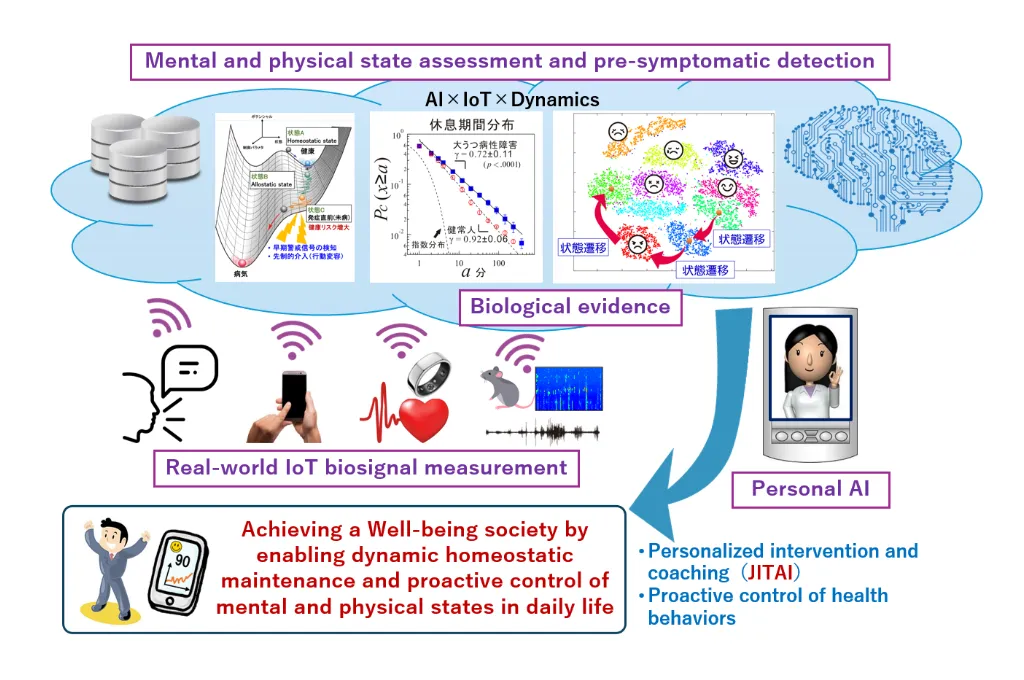
We conduct research to objectively evaluate mental and physical states, disease risk, and pre-disease conditions using real-world biosignals. We employ dynamic indicators that describe the state and temporal changes of biological systems as digital biomarkers, including behavioral statistical laws observed in the duration patterns of activity and rest, as well as critical slowing-down phenomena that arise during disease transition periods. These approaches support the development of methods for the objective assessment and early detection of conditions such as mental disorders. Furthermore, under the concept of Ecological Affective Computing, we are developing techniques to estimate emotional states from biosignals collected in daily-life environments. We also conduct comparative studies with disease model animals to identify universal digital biomarkers and elucidate their underlying biological mechanisms.
Behavior Change through Just-in-Time Adaptive Intervention (JITAI)
We are advancing the research and development of Just-in-Time Adaptive Interventions (JITAI), which use real-time analysis of biosignals collected in daily life to deliver individualized interventions at optimal moments. Using our proprietary cloud-based IoT system, we continuously collect data on mood, physical activity, heart rate, sleep, and related parameters. By estimating individual states through machine learning and other analytical approaches, we are developing personalized intervention and coaching techniques, for example those aimed at improving sleep and reducing presenteeism among workers.
Dual-Task–Based Assessment of Cognitive Function and Future Decline
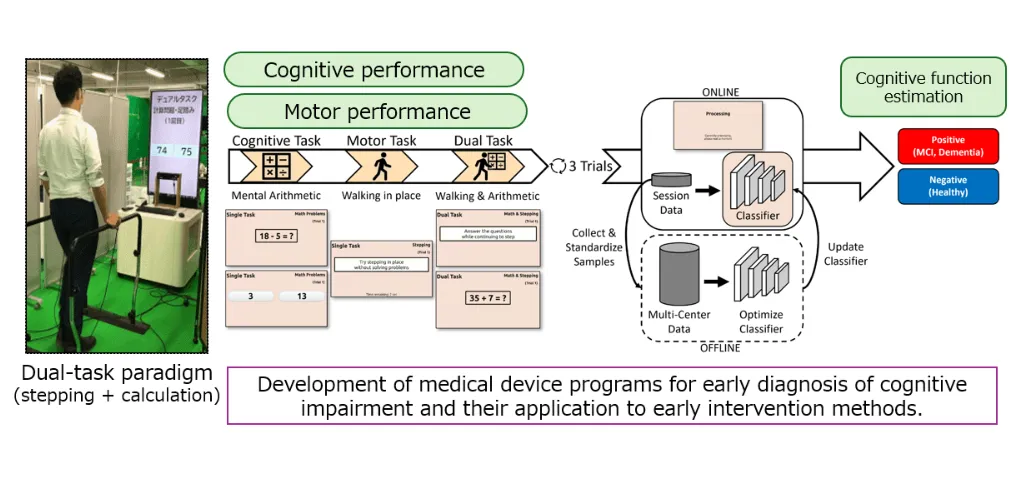
Dual-tasking is an experimental method that evaluates the brain's information processing capacity and attention allocation by requiring individuals to perform two tasks simultaneously. We have developed a dual-task system in which participants perform a calculation task while stepping in place. By analyzing both motor and cognitive performance during this task using deep learning and related techniques, we have developed methods to estimate current cognitive function and predict future cognitive decline. In addition, we have constructed the world's first dementia-related multimodal database, which includes task performance, movement data, electroencephalograms (EEGs), and facial expressions. This database is expected to improve the accuracy of cognitive function estimation and support its application in medical device programs.
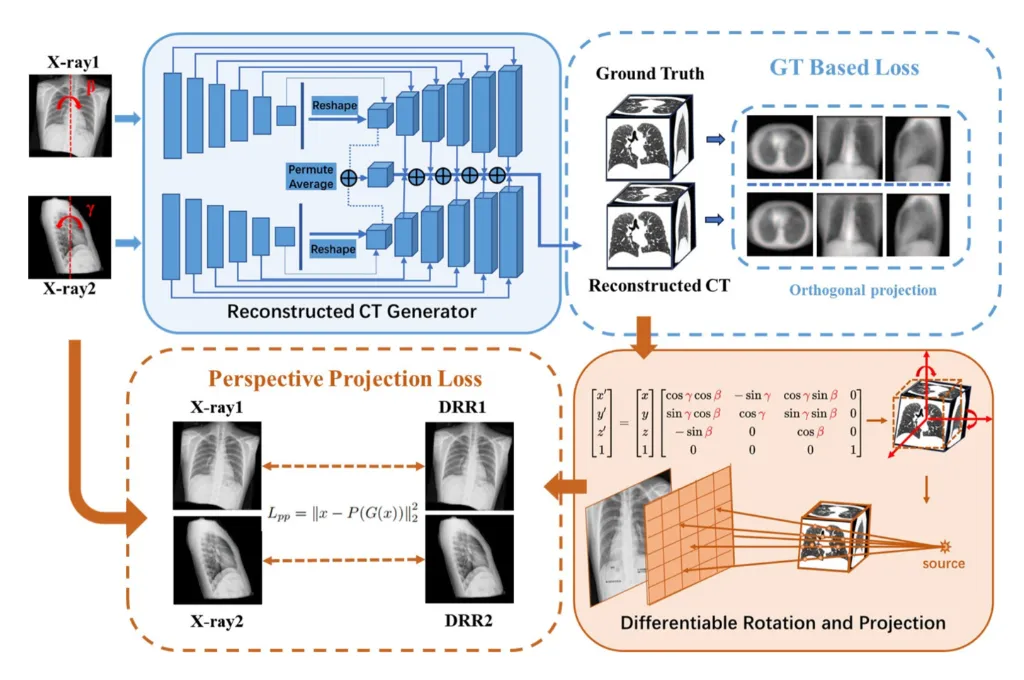
Development of 3D CT Reconstruction Methods from 2D X-ray Images
Reconstructing 3D Computed Tomography (CT) images from 2D X-ray images is a significant challenge in medical image analysis. However, existing methods often exhibit reduced reconstruction accuracy when the subject, such as an organ, undergoes postural changes, which limits their practical utility in clinical settings. To address this issue, we are developing a novel machine learning–based method for reconstructing 3D CT images from 2D X-ray images, accounting for posture rotation.